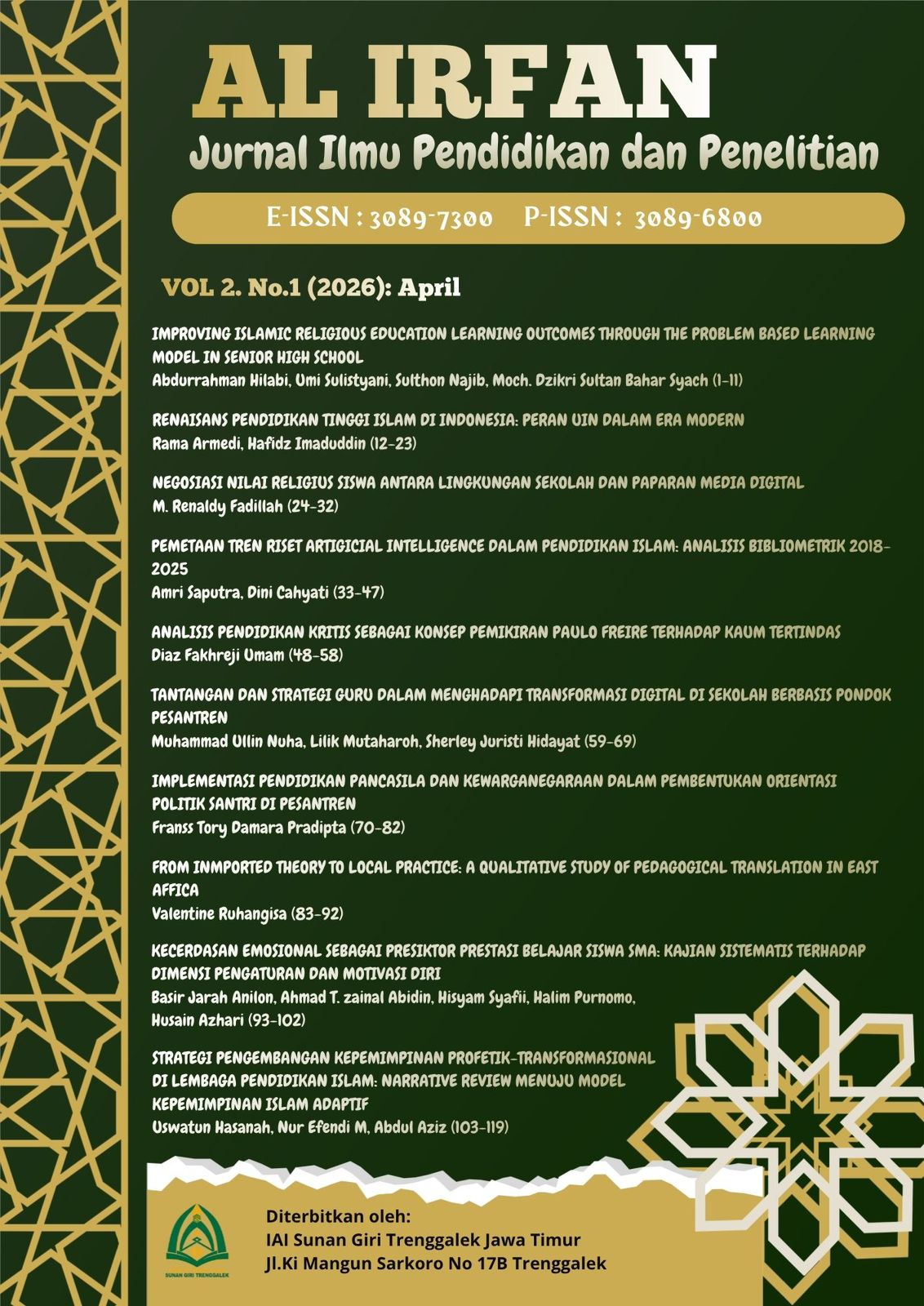
PEMETAAN TREN RISET ARTIFICIAL INTELLIGENCE DALAM PENDIDIKAN ISLAM: ANALISIS BIBLIOMETRIK 2018-2025
DOI:
https://doi.org/10.64877/alirfan.v2i1.79Keywords:
Artificial Intelligence, Bibliometric Analysis, ChatGPT, Islamic Education, Research TrendsAbstract
The integration of Artificial Intelligence (AI) into religious education systems has become an increasingly pressing topic amidst the global digitalization wave. This study aims to map the scientific landscape, growth trends, and conceptual structure of research regarding the application of AI in Islamic Education. Employing a bibliometric analysis approach assisted by the R-package Biblioshiny software, this study analyzed 30 selected documents published between 2018 and 2025. The results indicate that this topic is a rapidly emerging research field, characterized by a high annual growth rate of 51.12%. A significant surge in publications was identified starting in 2023, strongly correlating with the emergence of generative AI technologies. Geographically, Indonesia dominates the global contribution map as the most productive and most cited country, far surpassing other nations. Thematic analysis reveals that current research focus centers on the use of ChatGPT in higher education and the development of intelligent technologies for Quran memorization. This study concludes that although still in its nascent stage, the integration of AI in Islamic education holds immense potential but requires broader international research collaboration.
References
Aria, M., & Cuccurullo, C. (2017). bibliometrix: An R-tool for comprehensive science mapping analysis. Journal of Informetrics, 11(4), 959–975. https://doi.org/10.1016/j.joi.2017.08.007
Boyack, K. W., van Eck, N. J., Colavizza, G., & Waltman, L. (2022). Characterizing in-text citations in scientific articles: A large-scale analysis. Journal of Informetrics, 16(2), 101282. https://doi.org/10.1016/j.joi.2022.101282
Broadus, R. N. (1987). Toward a definition of “bibliometrics.” Scientometrics, 12(5–6), 373–379. https://doi.org/10.1007/BF02016680
Chen, L., Chen, P., & Lin, Z. (2020). Artificial Intelligence in Education: A Review. IEEE Access, 8, 75264–75278. https://doi.org/10.1109/ACCESS.2020.2988510
Cobo, M. J., López-Herrera, A. G., Herrera-Viedma, E., & Herrera, F. (2011). Science mapping software tools: Review, analysis, and cooperative study among tools. Journal of the American Society for Information Science and Technology, 62(7), 1382–1402. https://doi.org/10.1002/asi.21525
Cukurova, M., Miao, X., & Brooker, R. (2023). The use of artificial intelligence in education: A systematic review of the literature. Computers and Education: Artificial Intelligence, 4, 100114. https://doi.org/10.1016/j.caeai.2023.100114
Donthu, N., Kumar, S., Mukherjee, D., Pandey, N., & Lim, W. M. (2021). How to conduct a bibliometric analysis: An overview and guidelines. Journal of Business Research, 133, 285–296. https://doi.org/10.1016/j.jbusres.2021.04.070
Fahimnia, B., Sarkis, J., & Davarzani, H. (2015). Green supply chain management: A review and bibliometric analysis. International Journal of Production Economics, 162, 101–114. https://doi.org/10.1016/j.ijpe.2015.01.003
Groos, O. V., & Pritchard, A. (1969). Statistical bibliography or bibliometrics? Journal of Documentation, 25(4), 344–349. https://doi.org/10.1108/eb026482
Halstead, M. (2004). An Islamic concept of education. Comparative Education, 40(4), 517–529. https://doi.org/10.1080/0305006042000284510
Ifenthaler, D., & Schumacher, C. (2023). Student perceptions of generative artificial intelligence in higher education. Computers and Education: Artificial Intelligence, 4, 100129. https://doi.org/10.1016/j.caeai.2023.100129
Kasneci, E., Sessler, K., Küchemann, S., Bannert, M., Dementieva, D., Fischer, F., Gasser, U., Groh, G., Günnemann, S., Hüllermeier, E., Krusche, S., Kutyniok, G., Michaeli, T., Nerdel, C., Pfeffer, J., Poquet, O., Sailer, M., Schmidt, A., Seidel, T., … Kasneci, G. (2023). ChatGPT for good? On opportunities and challenges of large language models for education. Learning and Individual Differences, 103, 102274. https://doi.org/10.1016/j.lindif.2023.102274
Limna, P., Kraiwanit, T., & Jermsittiparsert, K. (2024). Artificial intelligence in education: A bibliometric study and future research agenda. Heliyon, 10(2), e24000. https://doi.org/10.1016/j.heliyon.2024.e24000
Luckin, R., Holmes, W., Griffiths, M., & Forcier, L. B. (2016). An argument for AI in Education.
Saputra, A. (2025). Pembelajaran Interaktif Di Sekolah Dasar Di Indonesia: Tinjauan Sistematis Literatur Tahun 2010-2025. 4.
Saputra, A., Hijriyah, U., Romlah, L. S., Susanti, A., Sunarto, & Shabira, Q. (2025). Trends and Developments in Gamification for Science Education: A Bibliometric Review from 2019 to 2023. Jurnal Penelitian Pendidikan IPA, 11(1), 30–44. https://doi.org/10.29303/jppipa.v11i1.10169
Sein Minn. (2022). AI-assisted knowledge assessment techniques for adaptive learning environments. Computers and Education: Artificial Intelligence, 3, 100050. https://doi.org/10.1016/j.caeai.2022.100050
Selwyn, N. (2023). Generative AI and the future of education. Learning, Media and Technology, 48(4), 1–5. https://doi.org/10.1080/17439884.2023.2235510
Thelwall, M. (2023). The effect of publication age on citation counts: A longitudinal analysis. Scientometrics, 128(5), 2783–2801.
https://doi.org/10.1007/s11192-023-04678-5
UNESCO. (2021). AI and education: Guidance for policy-makers. UNESCO. https://doi.org/10.54675/PCSP7350
Van Eck, N. J., & Waltman, L. (2010). Software survey: VOSviewer, a computer program for bibliometric mapping. Scientometrics, 84(2), 523–538. https://doi.org/10.1007/s11192-009-0146-3
Waltman, L. (2023). A review of the literature on citation impact indicators. Journal of Informetrics, 17(1), 101280. https://doi.org/10.1016/j.joi.2022.101280Yves, P., & Christine, R. (2017). European framework for the digital competence of educators: DigCompEdu. Publications Office. https://doi.org/10.2760/159770
Zawacki-Richter, O., Marín, V. I., Bond, M., & Gouverneur, F. (2019). Systematic review of research on artificial intelligence applications in higher education – where are the educators? International Journal of Educational Technology in Higher Education, 16(1), 39. https://doi.org/10.1186/s41239-019-0171-0
Zhai, X., Chu, X., Chai, C. S., Jong, M. S. Y., Istenic, A., Spector, M., Liu, J.-B., Yuan, J., & Li, Y. (2024). A review of artificial intelligence (AI) in education from 2010 to 2023. Education and Information Technologies, 29, 1–27. https://doi.org/10.1007/s10639-023-12141-0
Zupic, I., & Čater, T. (2015). Bibliometric Methods in Management and Organization. Organizational Research Methods, 18(3), 429–472. https://doi.org/10.1177/1094428114562629