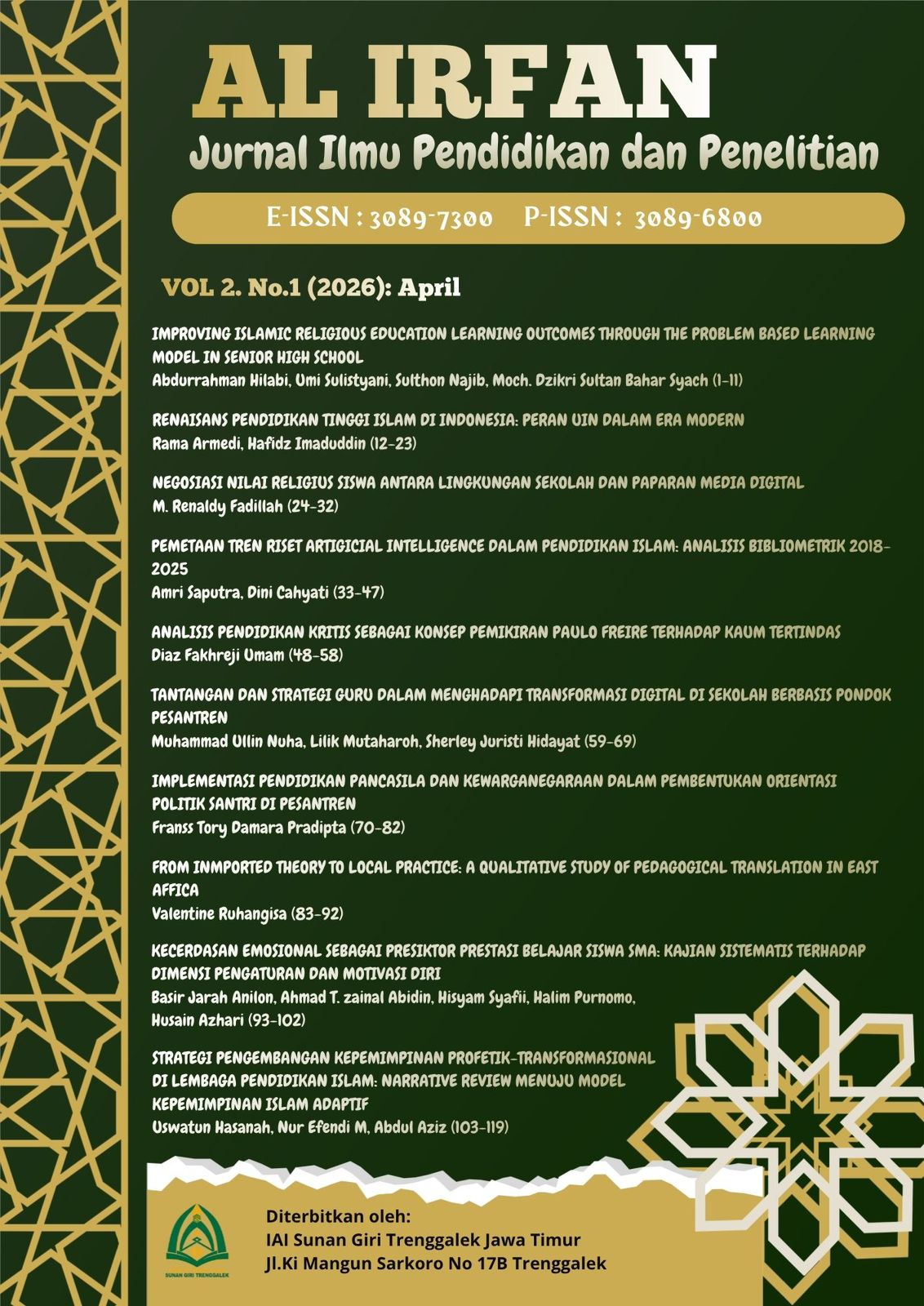
KECERDASAN EMOSIONAL SEBAGAI PREDIKTOR PRESTASI BELAJAR SISWA SMA: KAJIAN SISTEMATIS TERHADAP DIMENSI PENGATURAN DAN MOTIVASI DIRI
DOI:
https://doi.org/10.64877/alirfan.v1i1.71Keywords:
Educational psychology, Emotional intelligence, High school students, Learning achievement, Literature reviewAbstract
This study aims to examine the influence of emotional intelligence on the academic achievement of public high school students through a systematic literature review approach. Emotional intelligence is defined as an individual's ability to recognize, understand, manage, and express emotions adaptively, which includes five main dimensions: self-awareness, self-regulation, self-motivation, empathy, and social skills. This study uses a systematic literature review method guided by PRISMA (Preferred Reporting Items for Systematic Reviews and Meta-Analyses). A literature search was conducted through the Google Scholar, Sinta, and DOAJ databases using the keywords "emotional intelligence", "learning achievement", "emotional intelligence", and "academic achievement" with a publication period of 2014–2024. Of the total 87 articles identified, screening based on title and abstract resulted in 43 articles, then selection based on inclusion and exclusion criteria resulted in 18 articles that met the requirements for in-depth analysis. The inclusion criteria included articles discussing the relationship between emotional intelligence and academic achievement, written in Indonesian or English, having gone through a peer-reviewed process, and published in accredited journals. The synthesis results show that emotional intelligence has a positive and significant influence on the academic achievement of public high school students, with contributions ranging from 21% to 34% (R² = 0.21–0.34; p < 0.05). The dimensions of self-regulation and self-motivation were shown to be the most dominant components in influencing student academic achievement. In addition, this relationship was moderated by factors of self-confidence, parental support, and a conducive school climate. The conclusion of this study confirms that the development of emotional intelligence needs to be systematically integrated into educational programs in schools to produce students who excel academically as well as emotionally and socially mature.
References
Batubara, V., & Nasution, A. (2025). Hubungan kecerdasan emosional dan motivasi belajar terhadap hasil belajar biologi kelas X SMA Swasta Katolik Budi Murni 3 Medan. Jurnal Teknologi Pendidikan (JTP).
Fathiyah, M. D., Rahma, O., & Aminah, S. (2022). Pengaruh kecerdasan emosional dan kemandirian belajar terhadap prestasi belajar mata pelajaran ekonomi siswa kelas XII SMA Negeri 33 Jakarta. Humantech: Jurnal Ilmiah Multidisiplin Indonesia, 2(Special Issue 2), 569–578. https://doi.org/10.32670/ht.v2i Special Issue 2.1358
Goleman, D. (2015). Emotional intelligence: Kecerdasan emosional mengapa EI lebih penting daripada IQ. PT Gramedia Pustaka Utama.
Halawa, T., Alsa, A., & Lubis, I. S. L. (2024). Hubungan antara kecerdasan emosional terhadap prestasi belajar pada siswa SMP N 23 Medan. Indonesian Research Journal on Education, 4(4), 2480–2488. https://doi.org/10.31004/irje.v4i4.1666
Khasanah, N., & Oktiani, N. (2024). Pengaruh perhatian orang tua dan kecerdasan emosional terhadap hasil belajar siswa. JIBEMA: Jurnal Ilmu Bisnis, Ekonomi, Manajemen, dan Akuntansi, 1(3), 223–233.
Kurnia, H., & Wahono, J. (2021). Pengaruh kecerdasan emosional terhadap prestasi belajar Pendidikan Pancasila dan Kewarganegaraan siswa SMA Negeri 5 Yogyakarta. AoEJ: Academy of Education Journal, 12(1), 82–85.
Methley, A. M., Campbell, S., Chew-Graham, C., McNally, R., & Cheraghi-Sohi, S. (2014). PICO, PICOS and SPIDER: A comparison study of specificity and sensitivity in three search tools for qualitative systematic reviews. BMC Health Services Research, 14(1), 579. https://doi.org/10.1186/s12913-014-0579-0
Moher, D., Liberati, A., Tetzlaff, J., & Altman, D. G. (2009). Preferred reporting items for systematic reviews and meta-analyses: The PRISMA statement. PLoS Medicine, 6(7), e1000097. https://doi.org/10.1371/journal.pmed.1000097
Paul, J., & Criado, A. R. (2020). The art of writing literature review: What do we know and what do we need to know? International Business Review, 29(4), 101717. https://doi.org/10.1016/j.ibusrev.2020.101717
Purnama, I. M. (2016). Pengaruh kecerdasan emosional dan minat belajar terhadap prestasi belajar matematika di SMAN Jakarta Selatan. Formatif: Jurnal Ilmiah Pendidikan MIPA, 6(3).
Putwain, D. W., Wood, P., & Pekrun, R. (2022). Achievement emotions and academic performance: Longitudinal evidence and implications for emotional competence in education. Educational Psychology Review, 34, 165–189. https://doi.org/10.1007/s10648-021-09608-4
Sánchez-Álvarez, N., Berrios Martos, M. P., & Extremera, N. (2020). A meta-analysis of the relationship between emotional intelligence and academic performance in secondary education. Learning and Individual Differences, 81, 101909. https://doi.org/10.1016/j.lindif.2020.101909
Snyder, H. (2019). Literature review as a research methodology: An overview and guidelines. Journal of Business Research, 104, 333–339. https://doi.org/10.1016/j.jbusres.2019.07.039
Sumiati, S., Sumaryoto., & Kasyadi, S. (2024). Pengaruh kecerdasan emosional dan rasa percaya diri terhadap prestasi belajar ilmu pengetahuan sosial pada siswa SMP Negeri di Kota Depok. Herodotus: Jurnal Pendidikan IPS, 7(3), 412–422.
Syafii, H., & Purnomo, H. (2024). Analisis Komparatif Pendekatan Behavioristik dan Konstruktivisme Sosial dalam Pembentukan Akhlak: Perspektif Neurosains Kognitif Islam: Comparative Analysis of Behavioristic Approaches and Social Constructivism in the Formation of Morals: Islamic Cognitive Neuroscience Perspective. TARBIYAH: Jurnal Pendidikan Dan Pembelajaran, 1(2), 155-167.
Syafii, H., Alaldaya, R., Purnomo, H., & Azhari, H. (2025). Psycho-philosophical structure of the concept of tazkiyatun nafs on the development of spiritual-emotional intelligence in students. Jurnal Studi Edukasi Integratif, 2(1), 62-71.
Syafii, H., Purnomo, H., Syukur, A., & Azhari, H. (2025). A The Effectiveness of Islamic Psychospiritual Approach in Mindfulness Program for Developing Teachers' Emotional Intelligence. EDUSHOPIA: Journal of Progressive Pedagogy, 2(2), 127-137.
Syafii, H., Rahmatullah, A. S., Azhari, H., & Alaldaya, R. (2025). Research Collaboration Patterns and Knowledge Structure in Asian Islamic Educational Psychology A Bibliometric Assessment. DIMAR: Jurnal Pendidikan Islam, 7(1), 119-135.
Syafii, M. H., Purnomo, H., & Matas, J. A. V. (2024). The Relationship Between Nomophobia and Boredom Intolerance in the Use of Social Media among Generation Z Muslim Students. International Journal of Islamic Educational Psychology, 5(2), 309-321.
Syafii, M. H., Purnomo, H., & Rahmatullah, A. S. (2025). Inclusive education and social transformation: analysing the role of education policy in increasing equality among rural students in Indonesia. Educational Research for Social Change, 14(1), 43-69.
Syafii, M. H., Purnomo, H., Ramadhan, C. S., & Azhari, H. (2024). Predictive Factors of Academic Procrastination: A Cross-Cultural Comparison between Indonesian and Egyptian Students. Psikis: Jurnal Psikologi Islami, 10(2), 319-329.
Taufik, A. K., Rista, N., & Dermawan. (2024). Pengaruh kecerdasan emosional terhadap prestasi belajar siswa pada mata pelajaran ekonomi di SMA Kapin Jakarta. Jurnal Ganec Swara, 18(4), 1865–1876.
Torraco, R. J. (2016). Writing integrative literature reviews: Using the past and present to explore the future. Human Resource Development Review, 15(4), 404–428. https://doi.org/10.1177/1534484316671606
Wismi, S. F., Supriyadi., & Putri, E. (2025). Pengaruh kecerdasan emosional terhadap prestasi belajar siswa di MTs Al Ihsan Pondok Gede Kota Bekasi. Arus Jurnal Psikologi dan Pendidikan, 4(3), 231–239. https://doi.org/10.57250/ajpp.v4i3.1678
Yunalia, E. M., Jayani, I., Suharto, I. P. S., & Susilowati, S. (2021). Kecerdasan emosional dan mekanisme koping berhubungan dengan tingkat stres akademik mahasiswa. Jurnal Keperawatan Jiwa (JKJ), 9(4), 869–878.